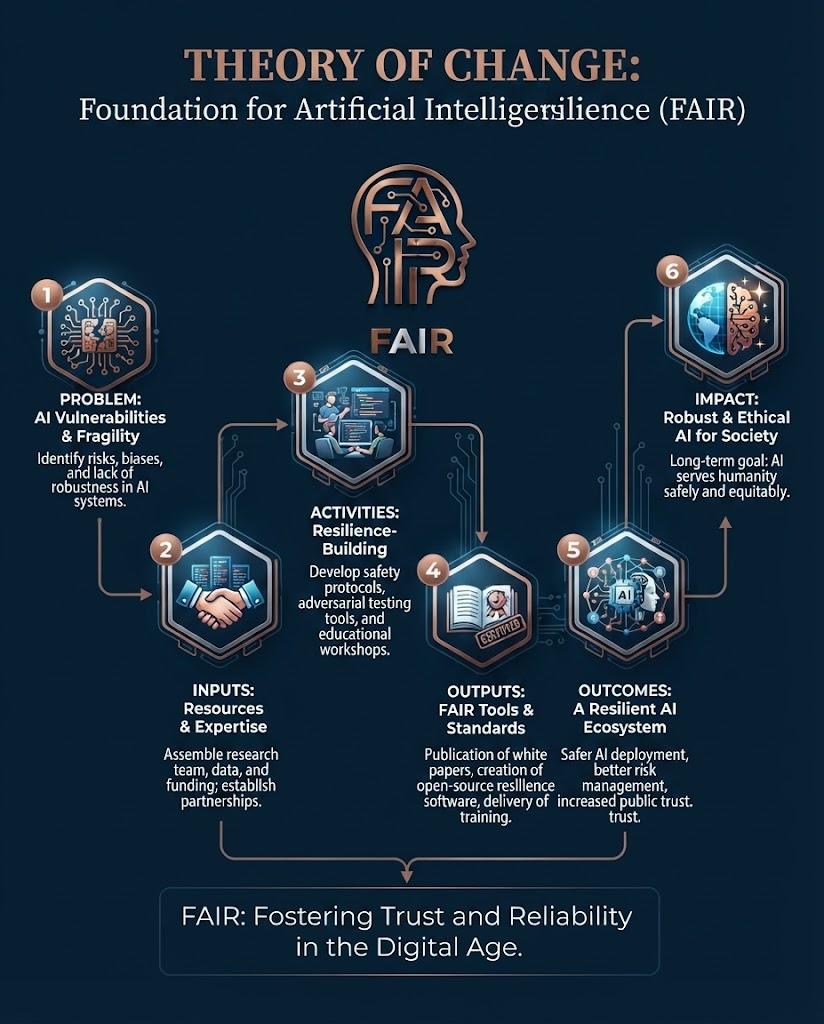
FAIR's Theory of Change begins with a concern: the current trajectory of artificial intelligence is not sufficiently sustainable because access to its resources, capabilities and opportunities remains deeply unequal.
These inequalities appear in different forms: access to computing infrastructure and AI tools, availability of specialist knowledge, digital skills, training opportunities, institutional capacity and the ability to participate in technological development.
FAIR believes these gaps weaken the resilience of the wider AI ecosystem.
Our first task is therefore to identify and measure inequality. Research initiatives such as the Digital Gap Index generate evidence about who has access, who does not and where significant gaps exist.
Evidence then informs training and knowledge development, helping expand access to the skills required to participate in the AI transformation.
Through innovation, FAIR and its partners explore approaches capable of broadening access and participation.
Finally, policy and advocacy translate evidence and experience into conversations with institutions and decision-makers capable of addressing structural barriers.
Our Theory of Change can therefore be expressed as:
Identify Gaps → Generate Evidence → Expand Knowledge & Access → Enable Participation → Influence Change → Increase Equality & Fairness → Strengthen AI Resilience → Support Sustainable AI
Our Pathway of Change
Inputs and Activities | Immediate Outcomes | Short-Term Outcomes: 1–2 Years | Medium-Term Outcomes: 2–3 Years | Long-Term Impact: 3+ Years |
|---|---|---|---|---|
Training programs | Trained individuals | Increased understanding of AI | Policy adoption and regulatory reform | A resilient, AI-aware ecosystem |
Capacity building | Higher AI literacy | Improved AI skills and competencies | Better collaboration between developers, technology providers, and users | Responsible AI integration across key sectors |
Hackathons and pilot projects | Expanded FAIR network | More informed public debate | New frameworks and best practices deployed | Individuals and institutions empowered to thrive alongside AI |
Conferences and webinars | Increased awareness | More proactive policy responses | Greater organisational preparedness | Reduced risks of bias, harm, and societal disruption |
Research and studies | Policy engagement | Stronger cross-sector relationships | Improved responses to AI-related threats and errors | More inclusive and accountable AI governance |
Policy briefs and white paper reviews | Shared knowledge | Increased community participation | Scaled pilots and practical implementation | Greater public trust in AI systems |
Guidelines and frameworks | Better access to resources | Stronger institutional capacity | Improved standards and oversight | Long-term social and technological resilience |